The AUD-denominated bond market has experienced significant growth, thanks to a bonanza of new issuance this year and a raft of offshore issuers attracted to the domestic market. This provides better diversification and returns for local investors, among other benefits, which we discuss in this note.
Growth in the Australian bond market
There’s been growing global demand for and interest in the AUD-bond market from both issuers and investors. It’s a trend we commented on last year that has gained further momentum over this year. In fact, the AUD investment grade corporate bond market is currently the third largest globally by new issuance after the USD and EUR bond markets.
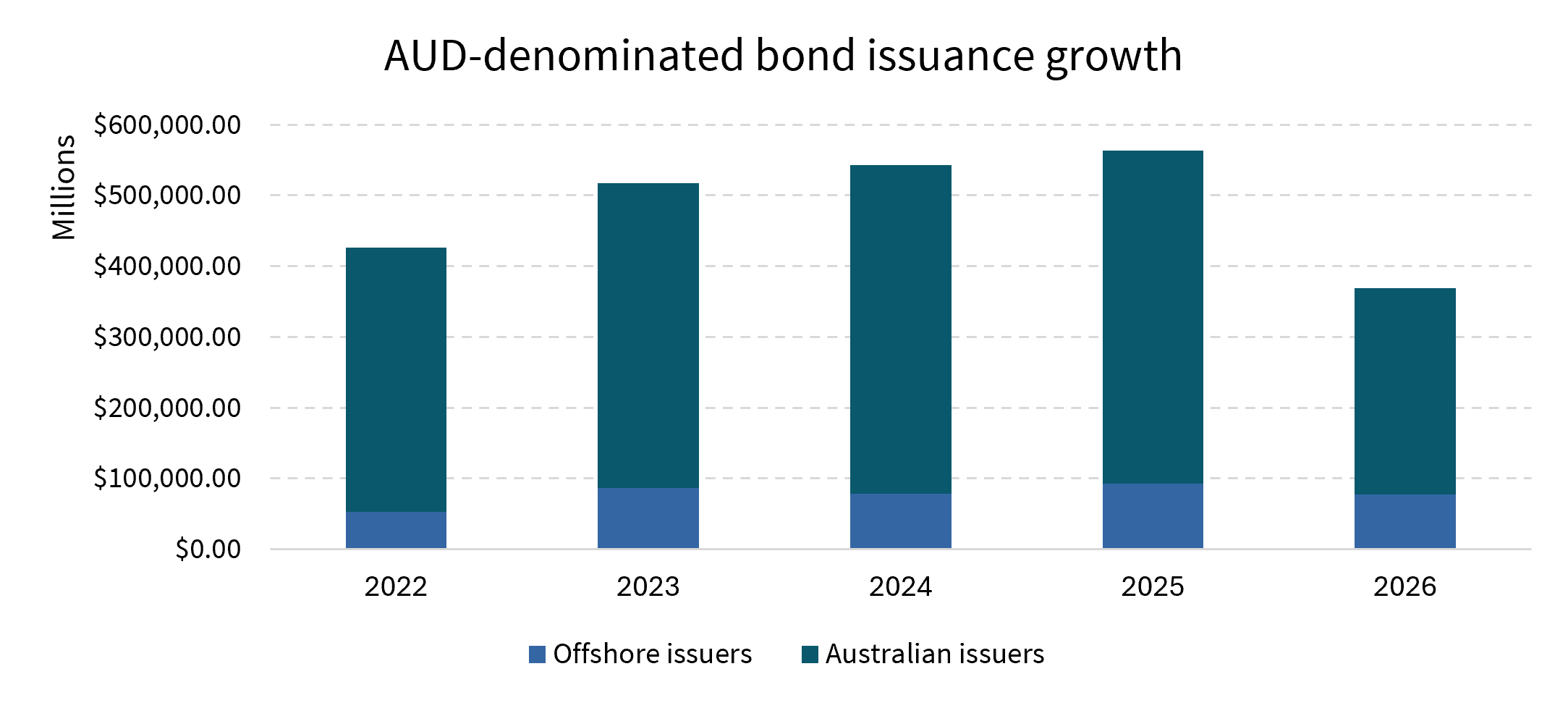
AUD-denominated issuance has grown steadily each year since 2022 (as shown in Figure 1). Should the current pace of new issuance and demand continue this year, issuance will significantly surpass the amount of growth we’ve seen in prior years. Figure 1 shows all AUD-denominated new issuance (including government, semi-government, and corporate issuance) from 2022 through July 15 this year (2026), split between Australian and offshore issuers.
Figure 1: AUD bond market growth by offshore and domestic issuer
Source: Bloomberg, FIIG Securities
While we’re only slightly over halfway through 2026, the amount of issuance this year is already 72% of the average annual issuance observed over the past four years. Furthermore, there’s been steady growth in the number of offshore issuers coming to the Australian bond market over the past five years. The size of kangaroo issuance (AUD-denominated bonds issued by an offshore issuer) as of July 15, 2026, was 62% of last year’s total issuance volume. We expect the total kangaroo issuance this year to significantly surpass last year’s, with many foreign issuers attracted to the Australian bond market for reasons we discuss below.
While the amount of issuance has grown, so too have the number of bonds coming to market, providing a wider choice for fixed income investors. In 2022, the total number of bonds in AUD issued was 250; however, the number of new issuances up until July 15, 2026, stands at 224. With the AUD bond market continuing to evolve and mature, it comes with many benefits for domestic investors. Here, we look at what’s driving growth and what it means for local fixed income investors.
Resilient economy, political stability and regulated market
One of the key drivers of the trend was originally diversification away from the US, with political instability and concerns around the independence of the US central bank following Liberation Day. However, the Australian bond market offers an attractive investment proposition in its own right. Noting Australia is one of only nine countries in the world that has a AAA sovereign credit rating from the major rating agencies (this is not something the US currently holds).
For offshore issuers, Australia has a relatively stable political and economic system, as well as an independent central bank. As such, there is less market uncertainty, which is supportive of new bond transactions. There has been a raft of new offshore issuers entering the AUD-bond market with debut kangaroo issues. This year’s debut offshore issuers have included Spanish telecommunications company Telefonica and Spanish bank CaixaBank (whose orderbook exceeded AUD3bn with strong demand).
Overseas investors are also attracted to Australia’s strong corporate governance and regulation by APRA and ASIC, giving investors more protection. The increase in offshore investors participating in new issuance has been evident, with 60% of Engie’s recent 5-year senior unsecured transaction allocated to investors based in Asia. In other transactions, the split of investors based in Asia has been as high as 80%, where historically this hasn’t been the case.
Given Australia’s resilient economy and strong regulatory environment, the default rate for corporate bonds in the over-the-counter (OTC) market also remains quite low comparatively. The last meaningful benchmark default in the Australian public corporate AUD bond market was Virgin Australia, which occurred in 2020 during the COVID-19 era. While there have been distressed credits, restructurings or private-credit losses since then, Virgin Australia remains the most recent widely syndicated issue to experience such an event. It is also worth noting that Virgin Australia’s bonds were rated sub-investment grade before the default and, as such, were viewed as a high-yield bond. Accordingly, the probability of default over time is considered much higher compared to an investment-grade exposure according to rating agency modelling.
Higher yields amongst peers
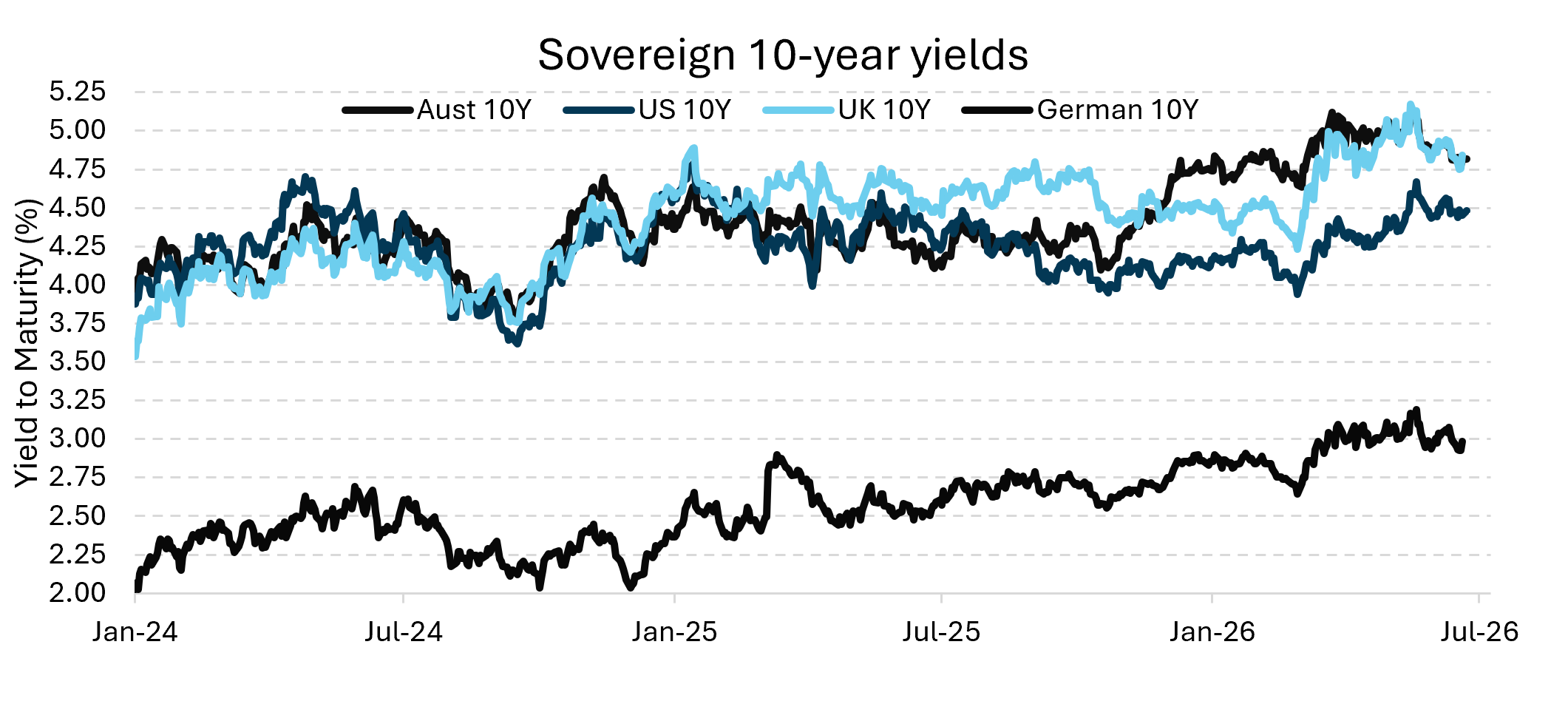
A key attraction for investors is the higher yields on offer in the AUD bond market, with base rates higher in Australia compared to other developed countries. There are a couple of factors at play here, but more broadly this is linked to the Reserve Bank of Australia (RBA) being one of the few central banks that was hiking rates prior to the US-Iran conflict in an effort to contain inflation. Other central banks are now also concerned about higher inflation since the spike in petrol prices caused by the conflict. However, the Australian Government bond curve was already pricing in a tightening cycle, whereas other sovereign yields were pricing in potential rate cuts.
The higher yields on offer in Australia are evident in Figure 2, which shows the sovereign 10-year bond yields of Australia, the US, the UK and Germany. While the UK 10-year gilt is also elevated, this is partly due to recent domestic political instability (the UK Prime Minister recently resigned), rather than stronger macroeconomic factors.
Figure 2: Australia, US, UK and German 10-year yields
Source: Bloomberg, FIIG Securities
Australia’s higher yields are due to its rate outlook and overall resilient economy (recent data hasn’t been as bad as one would think, given consecutive rate hikes, higher inflation, and an oil supply shock). Currently, investors can achieve a return of around, or over, 6.00% for an investment grade allocation. As we’ve commented on recently, given there’s likely only one more rate hike this year, if any, yields have remained somewhat elevated this late in the cycle.
Attractive for offshore issuers and investors
As the AUD bond market continues to attract new issuers, it creates a more liquid and deeper bond market, as well as diversification for domestic investors. It also creates supply and better pricing. At times when, for cyclical/seasonal reasons, new transactions from Australian issuers are limited, offshore issuers are now stepping in to satisfy demand. This has been the case for Tier 2 issuance from the major domestic banks.
The Australian major banks are already ahead of their minimum capital funding requirements and well positioned for the phasing out of Additional Tier 1 (AT1) hybrids from January 2027. As such, there haven’t been many new Tier 2 subordinated notes issued. With limited new supply in the space, and consistent demand, spreads have been grinding tighter on existing Tier 2 subordinated notes and new issues.
Historically, when supply has been limited, spreads have generally continued to tighten due to strong demand, but now, with the evolution of the AUD-bond market, offshore issuers are taking advantage of the tighter pricing and gap in the market. We saw this more recently with BPCE SA, the second largest banking group in France, issuing a new 15-year non-call 10-year Tier 2 fixed-to-floating rate note in the AUD-bond market.
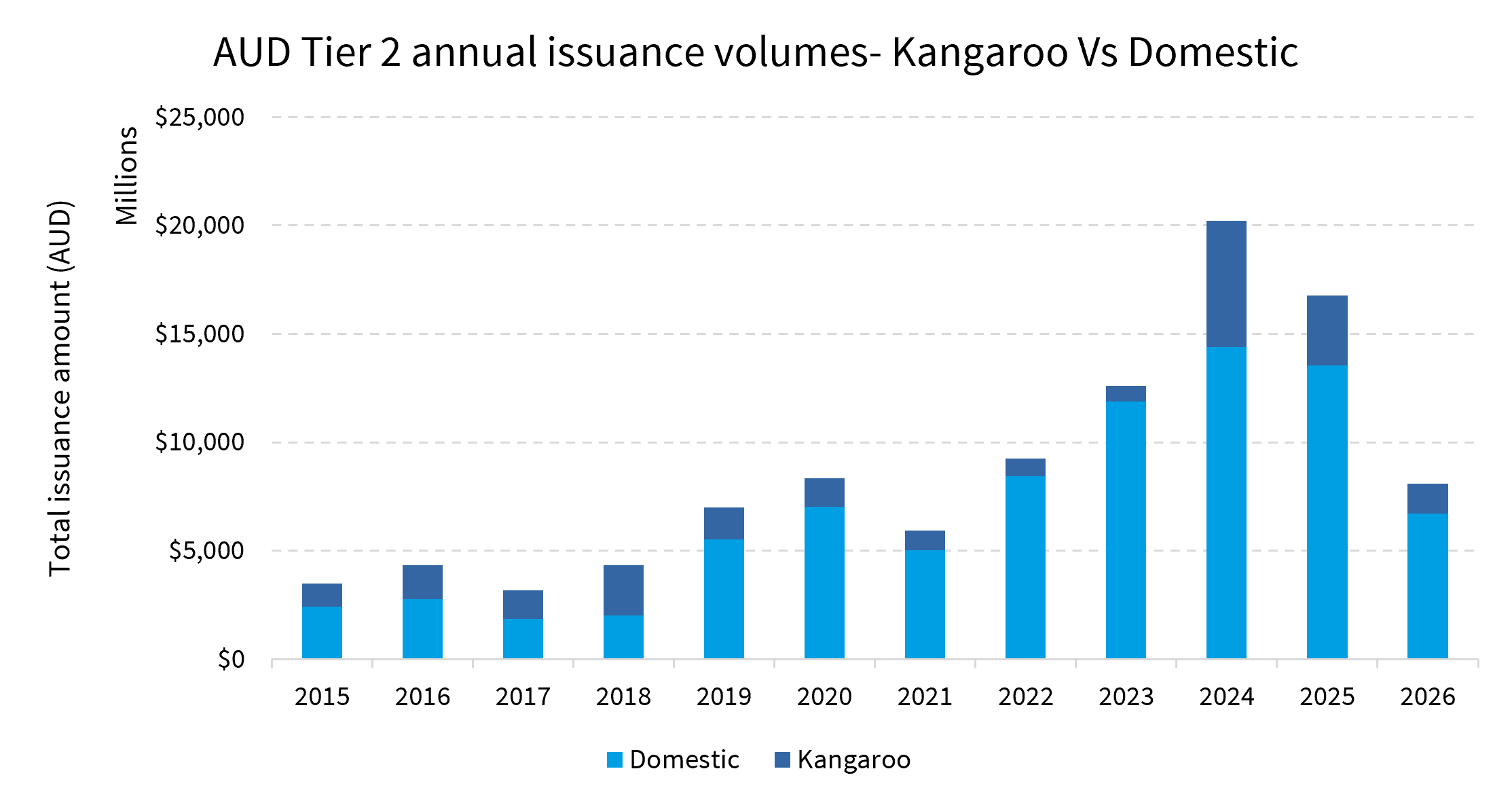
Figure 3 shows the amount of new Tier 2 issuance since 2015, split between domestic issuers and international issuers (kangaroo). It highlights both the overall increase in Tier 2 issuance over the years as the AUD-bond market matures, and, specifically, the increase in the amount of kangaroo issuance since 2024.
Figure 3: Tier 2 issuance split
Source: Bloomberg, FIIG Securities
This is beneficial for Australian bond market investors, as it provides additional supply and liquidity in the space, and should also limit how tight spreads will go when the Australian banks have fewer new issuance requirements. It also provides diversity to the AUD-bond market, where bond investors have access to issuers and sectors offshore that they typically wouldn’t be able to gain exposure to in their fixed income portfolios.
Alternative to ASX-listed bank hybrids
While offshore issuers are stepping in to fill demand for Tier 2 subordinated notes, and with a limited number of domestic banks issuing notes, a similar situation is unfolding with hybrid instruments (often referred to as subordinated notes). With APRA phasing out ASX-listed bank hybrids, there is another supply gap being created, where offshore and domestic issuers are stepping in to satisfy demand looking for alternative but similar investments. The only exception to the phasing out of hybrid instruments in Australia is for insurers, who are still able to issue hybrids if they please.
There has been an explosion in the number and size of subordinated notes being issued in the AUD-bond market, from a vast array of issuers, including banks, insurers and corporates. Noting these fixed income securities also have some unique features that typical bonds don’t, making them a ‘hybrid’ investment as the name suggests. Because of this, generally they offer a much higher return.
These OTC hybrid instruments have historically been issued in larger sizes in the Euro and USD-bond markets by offshore issuers, due to those markets being more mature and sophisticated. However, over the past year, the subordinated notes being issued domestically have grown significantly, with the likes of French multinational bank BNP Paribas, Swiss multinational bank UBS and British multinational bank Barclays issuing corporate hybrids in the AUD bond market.
One of the more notable offshore transactions was from Verizon Communications, which in November 2025 issued a multi-tranche subordinated notes issue to very strong demand. The orderbook was heavily bid, with investors placing AUD2.53bn of orders, but only AUD1.3bn of bonds were actually issued, resulting in the heavy scaling of orders.
While there’s been an uptick in the number and regularity of subordinated issuance from offshore issuers, this has also been the case for Australian issuers. Household names such as Lendlease, Transgrid (NSW Electricity Networks Finance Pty Ltd) and Melbourne Airport are among some of the domestic issuers of new subordinated notes over the past year.
Where investors were going to the ASX for this style of fixed income product prior to the regulatory changes, the OTC bond market is now offering an alternative product with more choice, better diversity across issuers, and improved returns to what the ASX-listed hybrid market could offer.
Conclusion
The AUD-bond market is having its day in the sun, with hot demand from both offshore issuers and investors, and it’s not a trend we expect to taper off soon. With its resilient economy, stable political and regulatory system, and high credit rating, Australia offers an attractive environment for issuers, while its higher base yields are also a drawcard for investors. This continual evolution of the AUD-bond market creates better diversification, liquidity and returns on offer for domestic investors, who gain exposure to issuers and sectors that otherwise would not be available.
If you’d like to discuss the role bonds could play in your portfolio, please contact your relationship manager of call 1800 01 01 81 or info@fiig.com.au.